
News & Events
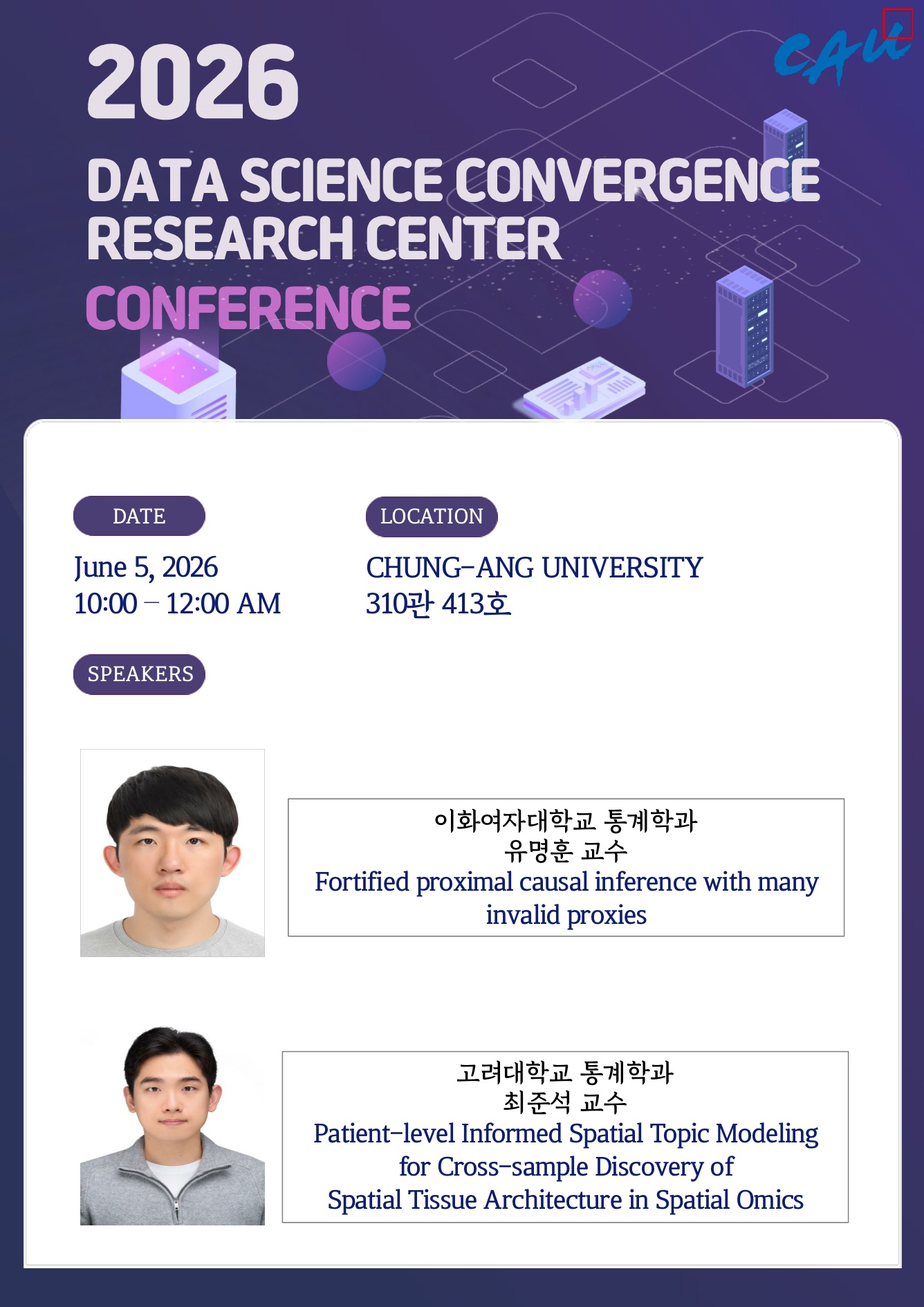
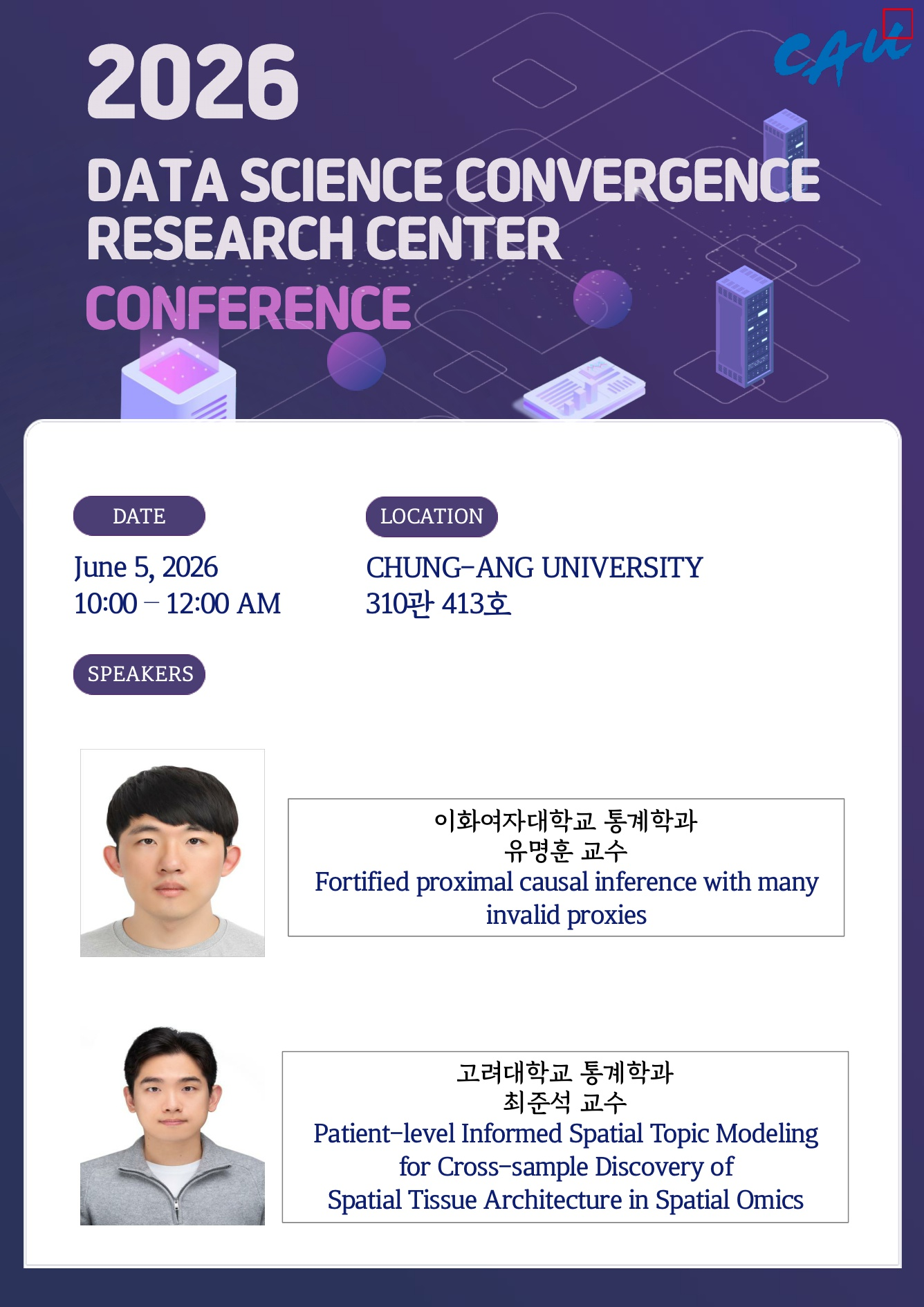
중앙대학교 데이터사이언스융합연구소에서 2026년 6월 5일 Conference를 개최합니다.
연사 : 이화여자대학교 통계학과 유명훈 교수, 고려대학교 통계학과 최준석 교수
일시 : 2026년 6월 5일 10:00-12:00 AM
장소 : 310관 413호
유명훈 교수 이화여자대학교 통계학과
Fortified proximal causal inference with many invalid proxies.
Causal inference from observational data often relies on no unmeasured confounding, an assumption that is frequently untenable when key covariates are unobserved or poorly measured. Proximal causal inference (PCI) addresses this problem by leveraging proxies for outcome and treatment confounding, but existing methods typically require that all specified proxies be valid, an assumption that is both restrictive and difficult to verify. We develop a semiparametric framework for many-proxy PCI that allows treatment-confounding proxies to be invalid. We introduce a class of fortified confounding bridge functions and establish nonparametric identification of the population average treatment effect (ATE) when at least γ of K candidate treatment confounding proxies are valid, for any analyst-specified γ ≤ K, without requiring knowledge of the valid subset. We further derive the local semiparametric efficiency bound and construct multiply robust, locally efficient ATE estimators that are robust to both invalid proxies and nuisance-model misspecification. We evaluate the proposed methods in simulations and apply them to study the effect of right heart catheterization among critically ill patients.
최준석 교수 고려대학교 통계학과
Patient-level Informed Spatial Topic Modeling for Cross-sample Discovery of Spatial Tissue Architecture in Spatial Omics
Characterizing how tissues are spatially organized is essential for understanding complex cellular interactions and how they relate to disease pathology and clinical outcomes. Emerging spatial omics technologies, such as spatial transcriptomics and multiplexed imaging, allow high-resolution characterization of cell phenotypes and their spatial arrangements, highlighting how tissue architecture shapes immune responses and influences disease progression. To systematically detect and characterize these structures, we propose a novel patient-level informed Bayesian spatial topic model. The method embeds spatial Gaussian processes within latent Dirichlet allocation, enabling flexible modeling of the spatial dependencies that underlie tissue organization. By analyzing multiple tissue samples jointly and incorporating clinical covariates to guide and refine inference, the approach recovers spatial structures that are consistent and coherent across samples, while also uncovering meaningful associations between these structures and patient characteristics. Across simulation studies with varying signal-to-noise ratios, our method consistently outperforms existing alternatives. Applied to a lung cancer multiplexed imaging dataset, it further reveals biologically meaningful tumor microenvironment patterns that recur across patients and are significantly associated with clinical outcomes.